Unreliable Temperature Control Disrupts Your Home Comfort
Experiencing the discomfort of a non-functional air conditioning or heating system can disrupt your daily routine, especially given the intense humidity levels common in Raceland. At Martin's Heating & Air Conditioning, we understand the urgency of HVAC issues and provide swift, reliable solutions to restore your environment. Call us immediately to schedule an assessment or discuss financing options for a new system:
- Immediate servicing with same-day appointment availability for urgent failures.
- Comprehensive inspections and transparent pricing with no hidden fees or surprise costs.
- High-quality installation and replacement performed by certified professionals.
All services are backed by warranties and in compliance with local building codes.
Comprehensive HVAC Installation Scope and Expectations
Investing in a new heating and cooling system involves more than simply swapping out one box for another. A proper installation ensures that the equipment operates at the manufacturer’s rated efficiency, provides consistent comfort, and lasts for its intended lifespan. When you schedule a replacement service, the focus remains on delivering a turnkey solution that addresses the specific thermal characteristics of your property.
Current industry standards require a holistic approach to system design. This includes evaluating the entire envelope of the home rather than just the mechanical unit. In areas like Raceland, where humidity control is just as critical as temperature reduction, the equipment must be perfectly matched to the square footage and insulation values of the structure. An oversized unit will cool the air too quickly without removing moisture, leading to a clammy indoor environment. An undersized unit will run continuously, driving up utility costs without ever achieving the set temperature.
The scope of a standard installation project generally includes the removal and disposal of existing equipment, ensuring environmental safety by capturing old refrigerant. Technicians assess the condition of the existing ductwork to verify it can handle the airflow of the new, more efficient system. Modern high-efficiency units often require different airflow parameters than older models. If the ductwork is compromised, leaks are sealed, or sections are replaced to prevent energy loss.
Included in a complete installation:
- Selection of the appropriate system type (Split System, Packaged Unit, or Heat Pump).
- Assessment and potential modification of refrigerant lines.
- Upgrading of electrical connections to meet current safety codes.
- Installation of a programmable or smart thermostat for better control.
- Fabrication of transition plenums to connect new equipment to existing ducts.
- Installation of auxiliary drain pans and safety switches to prevent water damage.
The System Replacement Process From Assessment to Operation
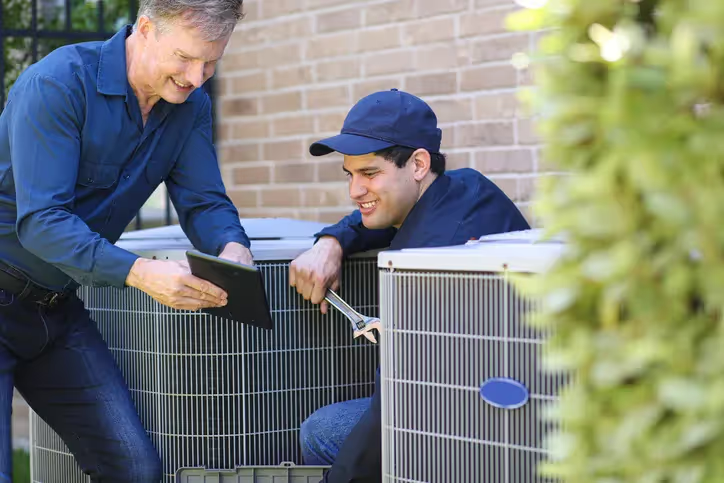
A systematic approach to installation minimizes downtime and ensures the longevity of the new unit. The process begins long before the physical installation takes place. A detailed load calculation determines the exact heating and cooling requirements of the building. This calculation, often referred to as a Manual J, accounts for window orientation, insulation levels, appliance heat generation, and occupant density. This data dictates the capacity of the system required.
Once the correct equipment is selected and the installation team arrives, the site is prepared to protect flooring and surrounding areas. The power to the existing HVAC system is disconnected, and the old refrigerant is recovered according to EPA guidelines. This is a critical step to prevent environmental contamination. The old condensing unit and air handler are then disconnected and removed from the property.
The installation of the new equipment follows a strict sequence:
- The new indoor air handler or furnace is positioned and leveled.
- The outdoor condensing unit is placed on a new composite pad to ensure stability and vibration isolation.
- Refrigerant lines are brazed using nitrogen purging techniques to prevent oxidation inside the pipes, which acts as a contaminant.
- Electrical wiring is connected, ensuring proper voltage and amperage delivery to the compressor and fan motors.
- A vacuum pump is used to evacuate air and moisture from the refrigerant lines, achieving a deep vacuum measured in microns.
Following the physical installation, the commissioning phase begins. This is where the system is tuned to optimal performance. Technicians check static pressure in the ducts to ensure airflow is neither restricted nor turbulent. Refrigerant charge is weighed in effectively, superheat and subcooling are measured, and the temperature split (the difference between supply and return air) is verified. This rigorous testing confirms that the system is ready to handle the Louisiana climate.
Determining When to Replace Your Current HVAC Unit
Deciding between another repair bill and a full system replacement is a financial and logical calculation. Homeowners often face this dilemma when a system breaks down during peak usage seasons. While repairs can offer a temporary fix, they are not always the most improved financial decision in the long run. Specific metrics help clarify when capital investment in a new system is more prudent than sinking money into an aging asset.
Age is the primary indicator. Most air conditioners and heat pumps have a service life of 10 to 15 years. If a system in Raceland has surpassed the 10-year mark and requires a significant repair, replacement is generally recommended. As components age, their efficiency drops, and the likelihood of a secondary failure increases. A compressor failure or a leaking evaporator coil in an older unit signals the end of the equipment's viable life.
The frequency of repairs also indicates the system's health. If a unit requires professional attention more than once a year, the cumulative cost of service calls and parts will quickly eclipse the monthly financing cost of a new, warranted system. Additionally, older systems operate on phased-out refrigerants like R-22. As supplies of these refrigerants dwindle, the cost to recharge a leaking system becomes prohibitively expensive — view current promotions to save.
Efficiency ratings play a massive role in this decision. Older units may have a SEER (Seasonal Energy Efficiency Ratio) of 10 or less. Modern standards require a minimum of SEER2 14.3 or higher in the southern region. Upgrading from a 10 SEER unit to a 16 SEER unit can result in substantial reductions in monthly energy consumption. If energy bills have been steadily climbing despite normal usage, the system is likely losing compression or heat transfer capability.
Consider replacement when:
- The cost of the repair equals 50% or more of the value of a new system.
- The system uses R-22 refrigerant.
- Different rooms in the house have significantly different temperatures (indicating failing airflow or compression).
- The unit makes excessive noise or emits odors during operation.
- Humidity levels inside the home remain high even when the AC is running.
Navigating Local Requirements and Climate Challenges
Operating an HVAC system in southern Louisiana presents unique challenges that standard installations may not address. The climate is classified as humid subtropical, meaning the equipment must battle intense moisture loads for the majority of the year. During installation, particular attention must be paid to condensate drainage. Because the system pulls gallons of water out of the air daily, drain lines must be correctly pitched, trapped, and insulated to prevent sweating and water damage to the home's structure.
Hurricane preparedness is another critical local factor. Outdoor units must be securely anchored to their pads using approved tie-down straps or brackets. This prevents the unit from shifting or tipping during high-wind events, which could rupture refrigerant lines or electrical connections. Martin's Heating & Air Conditioning ensures that every installation meets or exceeds these structural stability requirements.
Local building codes and permitting processes in the region dictate specific safety standards.
- Electrical disconnects must be located within sight of the outdoor unit for technician safety.
- Working space clearances around the indoor and outdoor units must be maintained to allow for future service.
- Breaker sizes and wire gauges must match the maximum overcurrent protection rating of the new unit.
Furthermore, voltage fluctuations and power surges are not uncommon during summer storms. Installing surge protection devices at both the disconnect and the main panel is a recommended localized strategy to protect the sensitive electronics found in modern variable-speed compressors and communicating thermostats.
Professional Standards in Equipment and Workmanship
The longevity of a heating and cooling system is determined 80% by the quality of the installation and only 20% by the brand of the equipment. Even the highest-rated premium equipment will fail prematurely if the installation does not adhere to physics and manufacturer specifications. Professional installation requires a blend of electrical, mechanical, and airflow expertise.
Certified technicians utilize specialized tools to verify that the installation is chemically and mechanically sound. Digital manifolds provide precise pressure readings, while anemometers measure air velocity. This data-driven approach removes guesswork. When a system is installed correctly, it operates quietly, maintains temperature within one degree of the thermostat setting, and effectively manages indoor humidity.
Warranties provide the final layer of protection for your investment. A standard installation typically comes with a manufacturer’s warranty on parts (often 10 years upon registration) and a labor warranty from the service provider. Understanding the distinction is vital. The parts warranty covers the replacement of a failed component, while the labor warranty covers the professional time required to diagnose and replace it.
Key differentiators in professional execution:
- Use of nitrogen during brazing to keep the system clean.
- Proper evacuation to below 500 microns to ensure a moisture-free system.
- Static pressure testing to verify ductwork health.
- Detailed owner orientation on thermostat operation and filter maintenance.
Get Professional Replacement Guidance Today
Secure the comfort and safety of your home with a professionally installed HVAC system designed to withstand the local climate. Do not wait for a complete system failure during the hottest days of the year.
Contact our team today to schedule your comprehensive system evaluation and replacement estimate.
Talk to a Local HVAC Expert

.avif)